


I’ve been quiet on Substack over the past few months. It’s not that I’m not bursting with things I want to share with you - I am. But I’m also trying to write a book on many of these same topics, and it turns out that writing anything else - including Substack posts - sucks time away from THE book. Also, I’ve had the distractions of a Bread Loaf Environmental Writers’ Conference (amazing!) and a new grandchild (even more amazing!) But, for now, I’m back!
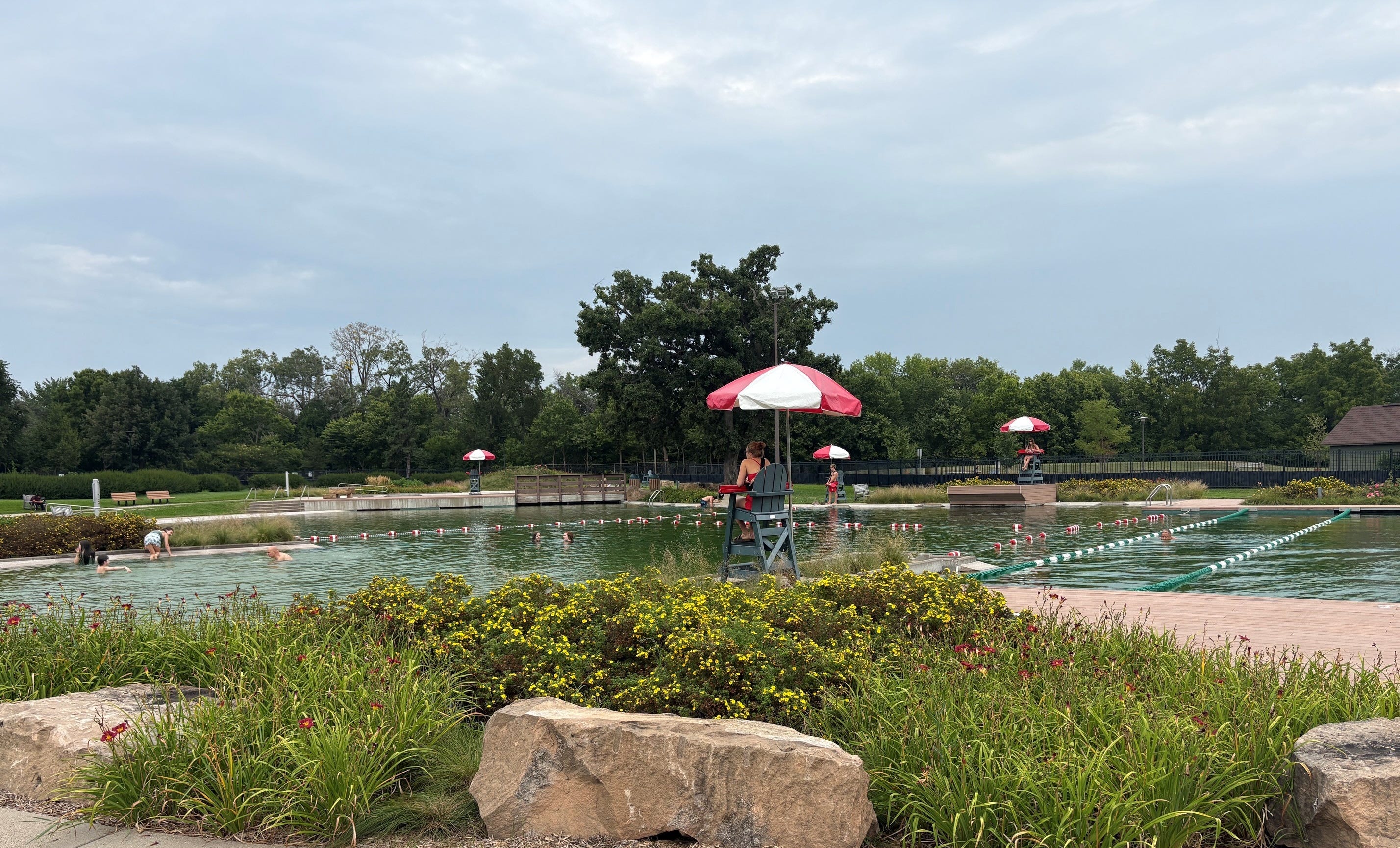
My husband and I had a swimming date last week. Our house is only three blocks from one of Minneapolis’ famed lakes where we can swim any summer day, but this mid-August outing was twelve miles north at a pool that I’d been waiting nine years to visit.
I first learned about the Webber Natural Swimming Pool during a national conference in 2017. Upon hearing that I’d moved to Minneapolis, a colleague’s voice crescendoed with enthusiasm. “I was just there” he told me. “You have to see this pool!” Bo lived in Mobile Alabama, more than 1,000 miles south, but all he wanted to talk about was Minneapolis’ new pool.
Overcast skies and 70-something air temperatures were not conditions that invite me to don a bathing suit, but this was the day that Marc and I had set aside for our outing, and I was determined to not let another summer slip away without making the pilgrimage. Sweaty from pedaling there – the Twin Cities are an urban cyclist’s heaven - Marc and I locked our bikes and grabbed our gear. Inside the bath house, teenage lifeguards – tan, sporting red bathing suits – asked if we’d been to the pool before. I kept my answer simple, a short “No”, skipping over the fact that I’d stalked the pool online and had many times examined it through locked gates during the off-season.
The reason I’d wanted so badly to try the pool out for myself was that it uses no chlorine. The Webber Natural Swimming Pool operates what is, as far as I can discern, the only public pool in the United States that operates without chlorine or other caustic chemicals. Instead, it lets nature, in the form of more than 7,600 aquatic and wetlands plants selected from 36 species, along with an entire ecosystem of zooplankton and microbes, do the work of consuming and filtering harmful bacteria and unappealing algae. The water-cleansing plants are all part of the “regeneration basin”, a nearly ½-acre constructed wetland/pond zone that cycles the pool’s water twice a day. It sits adjacent to the pool, just past the pool’s fence line.
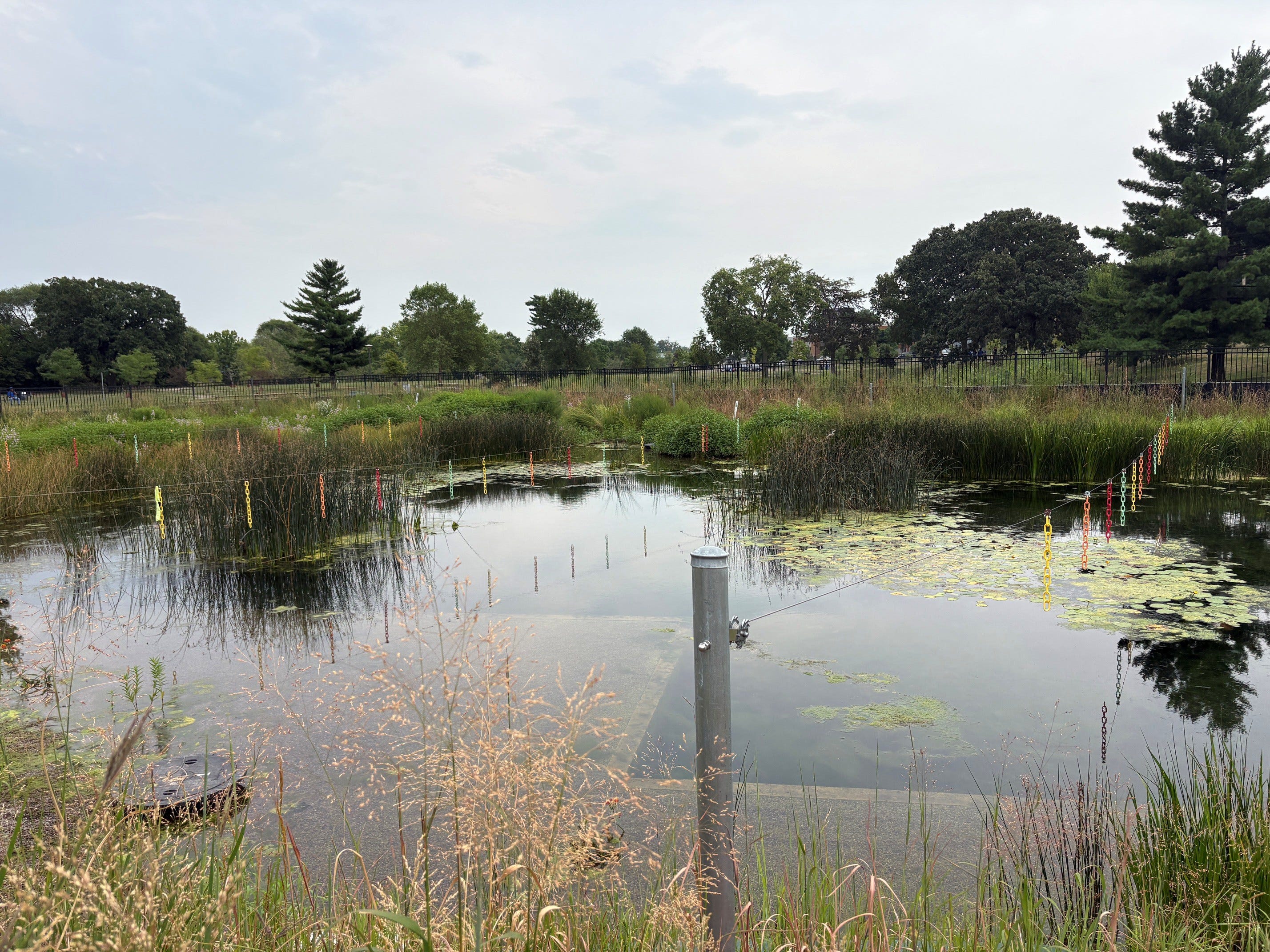
Other than the regeneration basin – which seemed of interest only to me on the day of our visit - much about the pool was familiar. Kids playing Marco Polo with their dad, languorous lifeguards calling out “Walk please” and “Don’t hang on the rope”, forty-somethings reclined in lounge chairs, deep in their novels. However, there were no picnic spreads nor even a snack bar. Food and drink (other than water) are strictly verboten, presumably to keep errant chip bags and straws out of the pool.
The pool’s shape is a blend of straight-lined, vertical-walled pools that grace cities and suburbs everywhere, and the graceful bends and shallows of natural ponds. Fanning arcs do their best to mimic a waveless beach, offering bathers a way to gently walk into the depths. In other places, vertical sides that we’ve come to expect in modern swimming holes allow quick entry for those who want to get right to it.
Five roped-off swim lanes welcome the serious swimmer. The otherwise free pool charges three dollars for swim lane access at the noon rush hour. But at 3 o’clock on a cool, cloudy day, the lanes were free – free of charge, and free of competition - so I slipped in to give them a try.
In no way am I a serious swimmer, but I’m accustomed to “wild” swimming, i.e. slowly stroking my way through natural water bodies, whether they be the urban lake near my house, the Virginia tidal river I return to each year, or a Great Lake in my adopted homeland. My friend Craig once talked me into a one-mile open-ocean swim as part of a fundraiser for Friends of the Virgin Islands National Park. I swam most of it in the company of a Labrador Retriever who felt responsible for making sure I didn’t finish last. This is all to say, I’m no stranger to chlorine-free swimming. I’ll take it any day over swimming in chemically treated water.
People who swim regularly know the ills of chlorine. Yes, it keeps bacteria at bay, but skin, hair, bathing suits, and respiratory systems pay the price. You could always pick out the competitive swimmers during my junior and senior high years – they were the ones with straw-like hair, often with a greenish hue.
The Webber Pool is hardly wild swimming, but the water itself is pretty darn close to being “wild”. When I took my turn in the swim lane, I didn’t expect anything different than swimming in my local pond. But I was wrong. My body cut through the water as if I were gliding across an air table, the kind used in physics classes to eliminate friction. No wonder they can charge $3 for the privilege.
Natural swimming pools have their roots in Europe, introduced in Austria in the 1980, with Germany opening the first public natural swimming pool in 1998. Europe now has tens of thousands, a mix of both public and private. Although still uncommon here, the U.S. has many unchlorinated private natural pools, but only one public pool.
I know of one other naturally unchlorinated pool in the United States, its origin story and mechanics are not at all like Webber’s. Capon Springs and Farms, an unassuming resort that’s been owned and operated by the same West Virginia family for nearly 100 years, features a spring-fed swimming pool that was once heralded as the “Best Swimming Pool in the U.S.” The story, as it was told to me by one of the Capon family members, was that when the West Virginia chlorine requirements were promulgated in the second half of the 1900’s, Capon wrangled an exemption.
The state health department lets the resort management off the hook for chlorine as long as they completely empty the pool twice a week and refill it with fresh spring water. As I’ve seen on countless visits with my family, on Wednesday and Saturday evenings, just before dinner, the pool’s plug is released, and its undoctored water slowly drains into the adjacent mountain creek. Once the pool is empty and its bottom has been hosed down, the plug is replaced and a pipe that comes directly from the resort’s iconic 100-gallon-per-minute spring starts refilling the primary pool and its adjacent kiddie pools. (I should note that not all 100-gallons per minute go to the pool - it has to share the bounty with all the other demands of running the accommodations.) But by morning, the pools are ready for anyone brave enough for the 65-degree water.
I’m not sure why no other community has followed Minneapolis’ footsteps to offer their residents an unchlorinated experience. I imagine that any existing pool with enough space could be retrofitted to add a natural “regeneration basin” or similar nature-based cleaning system. Maybe it’s just that their park leaders don’t know it’s a possibility. There’s an easy way to fix that!
Splash Zone
There’s no direct line between natural pools and the link I’m about to share other than that I’m passionate about both. My writing buddy Steve tipped me off on Netflix’ new documentary “Plastic Detox”. OMG. I just watched it and now I want to you do so as well. (It’s the fastest 92 minutes you’ll ever spend.)
Thank you Lynn. I’m a swimmer..slow but determined. I love being in water and Maria, another MPR Mexico City alum and I are 2 thirds of a triathlon team coming up. I’d love to try the chlorine free pool one of the days . Thanks for the inspiration. I plan to watch Plastic Detox. Thanks for the recommendation. Sandy
To
https://www.coloradounited.com/blog/glenwood-hot-springs-pool-complete-guide